Seeds are raised in local nurseries
All trees start their life in local nurseries in Tanzania, run by our partners.
Here, species are selected that:
- Are adapted to local conditions
- Support biodiversity
- Can thrive long term without artificial support



We do not plant trees as symbolism, but as long-term, measurable climate action focused on biodiversity and local communities
All trees start their life in local nurseries in Tanzania, run by our partners.
Here, species are selected that:
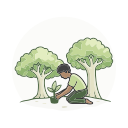
When the trees are strong enough, they are planted in selected areas.
We ensure that:
We do not plant monocultures, but varied forest systems.

All trees planted through Treesy are:
Tree planting at Treesy does not stop the day the tree goes into the ground.
We do not plant monocultures, but create living, resilient forests with room for biodiversity.
To ensure climate impact, biodiversity and local value, we plant trees in the following distribution:
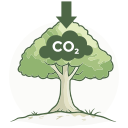
Large canopy trees that:
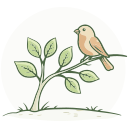
Native species that:
Productive trees that:
This balance is deliberately chosen to avoid uniform plantations and ensure a living, resilient forest.
Treesy plants a wide range of tree species to support climate, biodiversity and local needs.
N = native | E = non-native, but non-invasive
The species list is updated continuously as new plantings are made.
All trees planted through Treesy are individually registered, geotagged with GPS coordinates and connected to a specific planting area.
Where your trees stand
Which area they are planted in
Follow development over time
Trees in a tropical climate:

Tree planting is cheaper per tree than in Europe, which means:

We strengthen the economy and living conditions in the Global South:

One of Treesy's co-owners lives in Tanzania. That means we:
Instead, we prioritize transparency, documentation and physical presence.
An element that is the building block of all living material, including trees.
A gas formed when carbon binds with oxygen. CO₂ is what trees absorb through photosynthesis.
A unit of measurement that combines all greenhouse gases, such as methane and nitrous oxide, into one common metric.
Our estimates are based on:
We use a cautious average of 100 kg CO₂ per tree over its lifetime.
Many tree species, especially in tropical climates, are expected to absorb more. We have deliberately chosen to calculate conservatively because we would rather plant two trees too many than one too few.
Choose a package and become part of our mission to create living, resilient forests in Tanzania.